
Condition Guide — Hip, Knee & Ankle/Foot Pain
The chain that carries you through every step.
Hip, knee, and ankle/foot pain often trace back to how the whole leg moves together — weakness or tightness at one joint frequently shows up as pain at another.
01 — The Brief Answer
Three areas, all connected
The hip, knee, and ankle/foot work together as a chain — how one moves affects the load on the others. Pinpointing which joint (or joints) is actually driving your symptoms is the first step.
Hip & SI joint
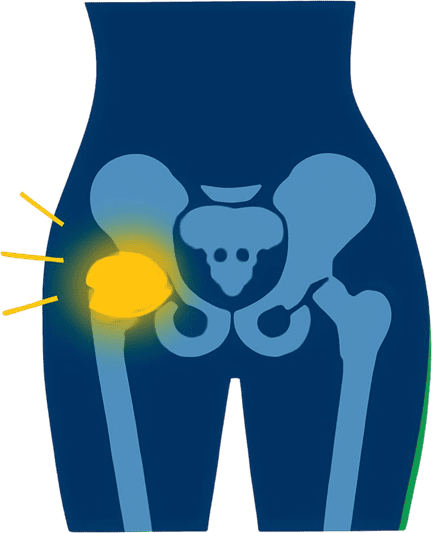
Pain in the buttock, hip, or groin that’s worse with standing on one leg, climbing stairs, or moving from sitting to standing — sometimes a deep ache, sometimes a sharp catch. Common causes include SI joint dysfunction, hip joint arthritis or impingement, muscle imbalance around the pelvis, and repetitive one-sided loading from running or sports.
Knee
Pain with bending, squatting, or climbing stairs, sometimes swelling or stiffness, a catching or giving-way sensation, and pain that’s often worse after activity or after sitting a long time. Common causes include patellofemoral pain from kneecap tracking issues, ligament or meniscus strain, overuse and tendinitis, arthritis, and muscle imbalance at the hip or ankle changing how load moves through the knee.
Ankle & foot
Pain, swelling, or instability at the numerous joints of the ankle and foot, with pain often worse with the first steps in the morning or after activity, sometimes with a rolled or “giving way” sensation. Common causes include ankle sprains, plantar fasciitis (heel and arch pain), Achilles tendinopathy, overuse from running or standing, arthritis, flat feet or high arches that changes. how load moves through the foot, and arthritis.
02 — Evaluation
How we figure out which joint is involved
Because pain can start in one joint and show up in another, the exam looks at the whole leg — hip to foot — not just where it currently hurts.
History
Where the pain is located and how it behaves, whether there was a specific injury, aggravating activities, and your current activity level.
Examination
Gait assessment, hip, knee, and ankle range of motion, swelling assessment, and palpation of the joints and surrounding muscles.
Orthopedic & neuro testing
Provocation testing for the hip and pelvis; ligament stability and meniscus testing for the knee; and ankle ligament stability testing plus palpation for plantar fasciitis or Achilles tenderness at the ankle and foot. Reflex, muscle strength and sensation testing of the affected area for suspected neurological issues.
When imaging or an outside referral makes sense
Most hip, knee, and ankle/foot pain improves with conservative care. We consider imaging or referral for significant trauma, suspected ligament or meniscus tears affecting stability, a joint that’s locked or significantly swollen, or no meaningful improvement after a reasonable trial of care.
03 — Treatment Options
Care built around what the exam finds
Not every case calls for every therapy below. An SI joint issue, a meniscus strain, and plantar fasciitis are treated quite differently, even when they show up on the same leg.
Chiropractic adjustment
Restores range of motion at the restricted joints found on examination, to promote proper recovery and of course reduce pain
Physical therapy & home exercise
Hip, knee, and ankle strengthening built around what’s actually weak or unstable, to improve load through the whole chain.
Joint mobilization & taping
Hands-on mobilization to improve mechanics at the hip, knee, or ankle, plus taping or bracing support where that helps during healing.
Massage therapy
Eases tightness in the hip, thigh, calf, and foot muscles that often accompanies joint dysfunction anywhere in the leg.
Acupuncture
Used with some patients as an adjunct for pain modulation alongside the rest of the plan.
Home & self-care
Activity modification, footwear guidance, and a home exercise routine to support recovery between visits.
Questions We Often Hear
They can feel similar, which is exactly what the exam — including specific provocation tests for each — is designed to sort out.
Conservative care can often help manage symptoms and improve function, though it doesn’t reverse joint changes — we’ll be upfront about what’s realistic for your case.
It’s irritation of the band of tissue that runs along the bottom of your foot, often causing sharp heel pain with the first steps in the morning. Treatment typically combines joint manipulation, soft tissue therapies such as ultrasound, electric muscle stimulation and instrument soft tissue manipulation, targeted stretching and strengthening, and footwear guidance. Every case is different so our team will tailor your treatment to your specific case.
Often yes, with some adjustments — we’ll point you toward what to modify based on what’s driving your specific pain.
Usually not right away, unless there are signs of significant ligament or meniscus involvement — we typically start with a trial of conservative care first.
Weakness or tightness at the hip can change how your whole leg moves, increasing stress further down the chain — which is why the exam looks at the hip, knee, and ankle together rather than just the joint that hurts. Also, it works the other way where ankle and foot dysfunction can put stress on the knee and hip.
Most plans focus on resolving the current episode and building enough strength and stability to prevent recurrence, not an indefinite schedule. In some cases, especially with chronic conditions, flare up care or maintenance care may be needed.
Research articles
Ready When You Are
Ready To Feel Better
Our team is here to help you move better, feel better, and live healthier