
Condition Guide — Neck Pain
The strain your neck carries all day.
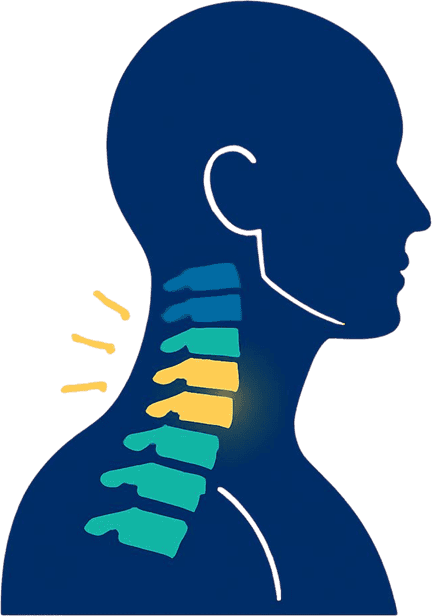
Neck pain is often driven by posture and hours spent looking down — but it can also come from disc or joint issues in the cervical spine.
01 — The Brief Answer
What neck pain actually is
Your neck is made up of joints, discs, muscles, ligaments, nerves, and other structures that all work together to support and move your head.
Because so many structures are located in a relatively small area, two people can both say “my neck hurts” and have very different examination findings.
Pain may be associated with restricted joint movement, muscle tension, weakness, repetitive strain, previous injury, irritated nerves, disc-related conditions, or a combination of factors.
That’s why identifying where you hurt is only the beginning.
We want to understand what is contributing to your pain and what is preventing your neck from moving and functioning normally.
Finding the Source of Your Neck Pain
Neck pain can make even simple activities uncomfortable—from turning your head while driving to working at a computer, sleeping, exercising, or getting through your normal day.
Sometimes neck pain begins suddenly after an injury or waking up with a stiff neck. Other times, it gradually develops from repetitive activities, muscle tension, work demands, posture, previous injuries, or changes in how the neck and upper back are moving.
At Family Chiropractic & Physical Therapy, we don’t assume that every case of neck pain has the same cause.
We start with a thorough examination to determine what structures may be contributing to your symptoms and develop a treatment plan based on what we actually find.
We commonly evaluate patients experiencing:
02 — Evaluation
How we figure out what’s driving it
Because neck pain can come from several different structures, the exam is built to find out which one is actually driving your symptoms.
History
We start by listening.
We’ll discuss when your pain began, where you feel it, what makes it better or worse, previous injuries, headaches, work and activity demands, and whether you’re experiencing symptoms such as numbness, tingling, weakness, dizziness, or pain traveling into your shoulder, arm, or hand.
We’ll also ask about previous treatment, imaging, medical conditions, and anything else that may influence your symptoms.
Most importantly, we screen for symptoms that may require additional medical evaluation or referral before beginning treatment.
Examination
Our examination takes a closer look at how your neck, upper back, shoulders, muscles, joints, and nerves are functioning.
Range of Motion
We assess how well you can turn, bend, flex, and extend your neck and whether certain movements reproduce or relieve your symptoms.
Joint & Motion Palpation
We evaluate how well the joints of the cervical and upper thoracic spine are moving and identify areas of restriction, tenderness, or altered mechanics.
Muscle & Soft-Tissue Assessment
We assess the muscles surrounding the neck, shoulders, and upper back for tension, tenderness, weakness, or other findings that may be contributing to your symptoms.
Orthopedic Testing
Specific orthopedic tests help us evaluate the cervical spine, discs, joints, muscles, and surrounding structures and narrow down the likely source of your pain.
Neurological Examination
When appropriate, we evaluate reflexes, sensation, muscle strength, and nerve function—particularly when symptoms include numbness, tingling, weakness, or pain traveling into the arm or hand.
Your examination helps us determine what your body needs—and whether chiropractic care, physical therapy, acupuncture, massage therapy, home exercise, additional imaging, referral, or a combination of services is the best fit for you.
03 — Treatment Options
Care built around what the exam finds
Not every case of neck pain calls for every therapy below. Posture-driven tension, a facet joint issue, and a disc-related case are treated differently, even though they can all feel similar at first.
Chiropractic adjustment
Individualized chiropractic adjustments may be used to address restricted or painful joint movement in the neck and upper back. Technique and positioning are selected based on your examination findings, comfort, medical history, and individual needs.
Physical therapy & home exercise
Individualized rehabilitation focused on improving neck and upper-back mobility, strength, stability, endurance, and movement patterns to help decrease pain and improve function.
Spinal decompression
For certain disc-related conditions or symptoms involving nerve irritation, non-surgical spinal decompression may be considered when appropriate based on your examination and diagnosis.
Massage therapy
Massage and soft-tissue techniques can help address muscle tension, tenderness, and discomfort throughout the neck, shoulders, upper back, and surrounding muscles.
Acupuncture
Acupuncture may be incorporated into your treatment plan to help manage neck pain, muscle tension, trigger points, and associated headaches when appropriate.
Home & self-care
Personalized exercises, stretches, strengthening, ergonomic recommendations, and activity modifications can help improve mobility and strength and allow you to continue progressing between visits.
04 — Additional Information
What If My Neck Pain Travels Into My Arm or Hand?
Neck problems don’t always stay in the neck.
Nerves exiting the cervical spine travel through the shoulder and arm into the hand. When a nerve is irritated or compressed, symptoms may include pain, numbness, tingling, burning, or weakness extending into the shoulder, arm, or hand.
However, not every numb or tingling hand is coming from the neck.
Similar symptoms can sometimes originate elsewhere along the path of the nerve or from other musculoskeletal or medical conditions.
That’s why your examination may include evaluation of your neck, shoulder, arm, reflexes, sensation, strength, and nerve function rather than assuming the neck is automatically responsible.
If your examination suggests that imaging, medical evaluation, or another specialist is appropriate, we’ll help guide you toward the next step.
Headaches & Neck Pain
Headaches and neck pain frequently occur together, but not every headache has the same cause.
Some headaches can be associated with structures in the neck or significant muscular tension, while others—including migraines and other headache disorders—may have different causes.
During your examination, we look at your neck movement, upper cervical and upper-back joint function, surrounding muscles, posture, neurological findings when appropriate, and the pattern of your headaches.
If your headache presentation suggests something outside of a musculoskeletal problem, we’ll recommend appropriate medical evaluation rather than assuming your headache is coming from your neck.
Acute vs. Chronic Neck Pain
Some patients come to us because they woke up yesterday and suddenly can’t turn their head.
Others tell us:
“My neck has bothered me for years.”
Both deserve an examination.
With a recent injury or sudden onset of pain, our initial goal may focus on determining what happened, reducing irritation, and gradually restoring comfortable movement.
With recurring or chronic neck pain, we may need to look beyond the painful area and assess mobility, strength, endurance, repetitive activities, work demands, previous injuries, and movement patterns that may be contributing to the problem.
The treatment plan should fit the person—not simply the diagnosis written on the chart.
Questions We Often Hear
No. Your treatment is based on your examination findings, medical history, diagnosis, comfort level, and personal preferences.
If cervical manipulation isn’t appropriate for you—or you simply aren’t comfortable with it—we can discuss other treatment options and techniques.
Muscle tightness can have many contributing factors. Muscles may be responding to repetitive activity, weakness, restricted joint movement, prolonged positioning, previous injury, stress, or other factors.
Rather than repeatedly treating the tight muscle alone, we want to determine why those muscles may continually be working harder than they should.
Certain types of headaches can originate from or be influenced by structures in the cervical spine. Other headaches, including migraines and many medical causes of headache, are more complex.
Your history and examination help us determine whether your neck appears to be contributing to your headache pattern and whether additional medical evaluation is appropriate.
Nerve irritation in the cervical spine can cause pain, numbness, tingling, or weakness that travels into the shoulder, arm, or hand.
However, similar symptoms can originate from other locations or conditions. A neurological and orthopedic examination can help us determine where your symptoms are most likely coming from.
Not necessarily. Imaging isn’t automatically required for every case of neck pain.
Your history and examination help determine whether imaging is appropriate. If we identify findings that warrant an X-ray, MRI, or additional medical evaluation, we’ll discuss that with you before proceeding.
Yes. Having pain for a long time doesn’t mean there is nothing that can be done.
Our first step is determining how your neck is functioning today. We’ll assess mobility, strength, joint movement, muscles, neurological function when appropriate, and other factors that may be contributing to your symptoms.
From there, we can determine what treatment and rehabilitation options are appropriate for you.
That’s exactly why we perform an examination first.
If your examination suggests that physical therapy, massage therapy, acupuncture, imaging, medical evaluation, or another specialist would be more appropriate, we’ll discuss those options with you.
Our goal is to help you find the right treatment for your problem, not simply fit every patient into the same treatment.
Research Supporting Neck Pain Care
Our approach is informed by current research on manual therapy, exercise, rehabilitation, and conservative treatment for neck pain.
Manual Therapy & Exercise for Neck Pain — Systematic Review & Meta-Analysis
Exercise for Chronic Neck Pain — Systematic Review & Meta-Analysis
Evidence-Based Clinical Practice Guidelines for Neck Pain
Ready When You Are
Ready To Feel Better
Our team is here to help you move better, feel better, and live healthier