
Condition Guide — Pediatric Care
Gentle Care, Sized For Kids
Kids aren’t small adults, and their care shouldn’t look like a scaled-down version of an adult visit. Pediatric chiropractic uses techniques matched to a child’s size, development, and comfort.
01 — The Brief Answer
Care That Grows With Your Child
Kids’ bodies are constantly changing.
From learning to hold their head up, roll, crawl, and walk to playground falls, sports, growth spurts, backpacks, technology, and everything in between, childhood places continually changing demands on the muscles and joints.
At Family Chiropractic & Physical Therapy, our approach to pediatric care starts with understanding why your child is having difficulty or discomfort.
We provide individualized, age-appropriate evaluation and conservative care for infants, toddlers, children, and teenagers experiencing musculoskeletal concerns, injuries, movement limitations, or pain.
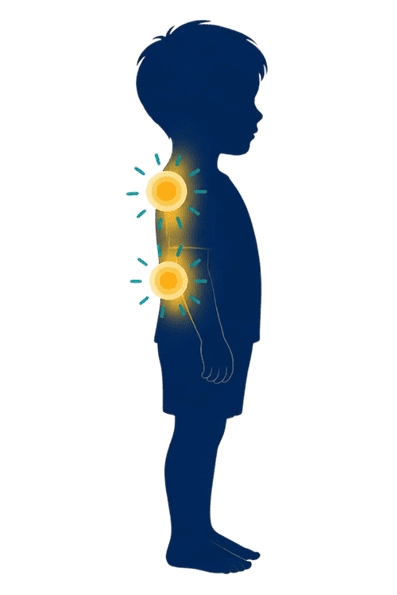
We commonly evaluate children experiencing:
02 — Evaluation
How We Adapt the Exam to Your Child’s Age
A pediatric examination should never simply be an adult examination performed on a smaller person.
Your child’s evaluation is adapted to their age, size, developmental stage, symptoms, comfort level, and reason for visiting us.
History
We start by listening to both you and your child.
Depending on their age, we’ll discuss pregnancy and birth history when relevant, developmental milestones, current symptoms, previous injuries, activities and sports, medical history, and any concerns you or your child’s healthcare providers have noticed.
For older children and teenagers, we’ll also ask about school, sports, repetitive activities, previous injuries, and what movements or activities make their symptoms better or worse.
Most importantly, we screen for symptoms or examination findings that may need to be evaluated by your child’s pediatrician or another healthcare provider before beginning treatment.
Examination
Your child’s examination is based on the reason they are coming to see us.
We may assess:
- Range of motion
- Posture and alignment
- Joint movement
- Muscle tension
- Strength
- Balance and coordination
- Walking or running mechanics
- Functional movement
- Orthopedic testing
- Neurological function when appropriate
For infants and young children, the examination is modified significantly and may include observation of comfortable movement, head and neck motion, positioning, age-appropriate motor skills, muscle tone, symmetry, and how they naturally move and interact with their environment.
We don’t expect a toddler to sit through an adult orthopedic examination.
We meet kids where they are.
Your child’s examination helps us determine what they need—and whether chiropractic care, physical therapy, massage therapy, home exercise, referral to another provider, or simply reassurance and monitoring is the best next step.
Care Changes as Kids Grow
Infants
An infant’s body is very different from an adult’s.
Evaluation is gentle and focused on movement, symmetry, comfort, and age-appropriate development.
Parents may bring an infant to us because they have noticed a preference for turning their head one direction, limited neck movement, unusual positioning, or another musculoskeletal concern.
When treatment is appropriate, techniques are modified specifically for an infant’s size and stage of development.
Toddlers & Young Children
Once children start crawling, walking, climbing, jumping, and exploring, their bodies encounter an entirely new set of challenges.
Falls and bumps are a normal part of childhood, but persistent pain, limping, avoidance of an activity, or changes in normal movement deserve a closer look.
At this age, examinations are often incorporated into movement and play so we can see how your child naturally uses their body.
School-Age Children
School, playground activities, backpacks, recreational activities, and organized sports begin placing greater physical demands on growing bodies.
We may evaluate children experiencing back or neck discomfort, headaches associated with musculoskeletal tension, extremity pain, sports injuries, or difficulty comfortably participating in activities they enjoy.
Teens & Young Athletes
Teenagers experience rapid growth while often participating in increasingly demanding sports and activities.
During growth spurts, strength, flexibility, coordination, training load, and recovery can all affect how an athlete feels and performs.
Our goal is not simply to help decrease pain. We want to identify what is contributing to the problem and help your child safely return to school, sports, hobbies, and everyday activities.
03 — Treatment Options
Care built around your child’s age
Not every visit calls for every therapy below. Your child’s plan is built around their age, activity level, and what the exam actually finds.
Chiropractic care
Age-appropriate chiropractic techniques may be used when examination identifies joint restrictions or musculoskeletal concerns. The technique, positioning, and amount of force used are modified based on your child’s age, size, comfort, and individual needs.
Physical therapy
Individualized rehabilitation to improve strength, mobility, balance, coordination, movement patterns, and function following injuries or when a child is having difficulty comfortably participating in normal activities.
Massage & Soft-Tissue Care
When appropriate for the child’s age and condition, soft-tissue techniques may help address muscle tension, soreness, or discomfort associated with activity and musculoskeletal complaints.
When We Refer
One of the most important parts of evaluating children is recognizing when something isn’t a chiropractic, physical therapy, or musculoskeletal problem.
If your child’s history or examination suggests that their symptoms require medical evaluation, imaging, developmental assessment, or another specialist, we’ll explain what we’re seeing and recommend the appropriate next step.
We want to be one part of your child’s healthcare team—not a replacement for their pediatrician.
Questions We Often Hear
Yes. Pediatric chiropractic care is safe when it is appropriately adapted to a child’s age, size, developmental stage, medical history, and individual needs.
Pediatric care looks very different from adult chiropractic care. We modify our examination, positioning, pressure, and techniques based on your child’s age and what we find during their examination. Infants and young children receive especially gentle, low-force techniques appropriate for their smaller, developing bodies.
Just as importantly, every child is examined before treatment. If we identify something that should be evaluated by your child’s pediatrician or another healthcare provider, we’ll make the appropriate referral rather than treating something outside of our scope.
No. An infant’s examination and treatment are specifically adapted to their size, anatomy, developmental stage, and comfort.
Infant chiropractic care is often described as feeling more like a light, gentle massage than what most people picture when they think of a traditional chiropractic adjustment. Many babies are so comfortable that they sleep through most—or even all—of their appointment.
As we gently evaluate their movement, muscles, and joints, babies may sometimes become fussy or show signs of discomfort when we reach an area that is tight, tender, or restricted. This helps guide our examination and allows us to focus care on what we are actually finding.
Our goal is always to keep care gentle, comfortable, and appropriate for your baby’s age and individual needs.
Babies can’t tell us when something feels tight, uncomfortable, or difficult—but they often show us through their movement, positioning, and behavior.
Parents may notice that their baby:
- Consistently prefers looking or turning their head in one direction
- Only rolls easily in one direction
- Seems uncomfortable or unhappy in their car seat
- Doesn’t like lying flat on their back
- Strongly dislikes tummy time
- Frequently rests in a curved or “C-shaped” position
- Appears tighter or moves differently on one side
- Has difficulty comfortably turning their head both directions
- Seems uncomfortable or strains when trying to have a bowel movement
These observations don’t automatically mean something is wrong or that your baby needs chiropractic treatment. Our role is to perform an age-appropriate examination of your baby’s movement, joints, muscles, positioning, and symmetry to determine whether there is a musculoskeletal component contributing to what you’re noticing.
If we find something outside of the musculoskeletal system or believe your baby needs additional evaluation, we’ll recommend involving their pediatrician or another appropriate healthcare provider.
Yes—when there is a musculoskeletal component contributing to your child’s symptoms, chiropractic care may be able to help. That’s why an examination is so important. We evaluate your child’s joints, muscles, movement, and overall musculoskeletal function to determine whether there are findings that may be contributing to what you’re noticing and whether chiropractic care is appropriate.
Chiropractic care does not replace evaluation or treatment from your child’s pediatrician when an infection, gastrointestinal condition, or other medical condition is present or suspected. We are happy to work alongside your child’s healthcare team when appropriate.
It’s also important to know that conditions such as colic, reflux, ear infections, and constipation by themselves are generally not diagnoses that insurance plans cover for chiropractic treatment. Coverage varies by insurance plan and is typically based on the musculoskeletal findings and diagnosis identified during your child’s examination.
If you’re wondering whether your child’s symptoms may have a musculoskeletal component or whether an evaluation would be appropriate, please reach out to our office. We’re happy to answer your questions.
Younger children don’t always describe pain the same way adults do.
Parents may notice limping, avoiding an activity, repeatedly rubbing an area, difficulty turning one direction, changes in sleep or activity because of discomfort, or suddenly not wanting to participate in something they normally enjoy.
A change from your child’s normal movement or behavior can be a reason to ask questions.
Yes. We evaluate many musculoskeletal complaints associated with sports and physical activity. Depending on the injury, care may include rehabilitation, mobility work, strengthening, activity modification, chiropractic care, or referral for imaging or additional medical evaluation when necessary.
We provide care from infancy through the teenage years. As soon as you feel comfortable bringing your baby in, we are happy to see them. In fact, the youngest patient we’ve cared for in our office was less than 72 hours old!
Every examination and treatment is adapted to your child’s age, size, developmental stage, and individual needs. What care looks like for a newborn is very different from what it looks like for a toddler, school-aged child, or teenage athlete.
Absolutely. If we identify something that requires additional evaluation or your child is already receiving care for a condition relevant to their treatment, we can coordinate with their healthcare team when appropriate.
Research Supporting Pediatric Musculoskeletal Care
Research on pediatric manual therapy continues to develop, and evidence varies considerably depending on the child’s age and condition. Our approach emphasizes appropriate examination, conservative treatment of musculoskeletal concerns, age-appropriate techniques, and referral when needed.
Ready When You Are
Ready To Feel Better
Our team is here to help you move better, feel better, and live healthier