
One nerve. A whole leg of pain.
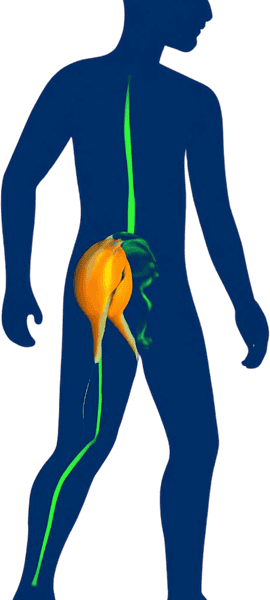
Sciatica follows a single, specific path — from the lower back, through the hip, down the back of the leg. Understanding that path is most of what it takes to understand your pain.
01 – The brief answer
Understanding Sciatica: Your Path to Relief
What Is Sciatica?
Sciatica isn’t a condition on its own, it’s a description of nerve pain. The sciatic nerve runs from your lower back down through your hips, legs, and feet. When your lower back or pelvis is aggravated, it irritates the sciatic nerve causing pain to travel along its path.
Common Symptoms:
What’s Causing Your Pain?
Because sciatica has several different sources, finding the root cause is the key to lasting relief:
02 – EJvaluation
How We Evaluate It (Do You Need an MRI?)
During your exam, we assess your spinal mobility, muscle reflexes, nerve tension, and hip function to pinpoint the exact source of irritation.
Most patients do not need immediate X-rays or an MRI. The majority of sciatica cases respond well to conservative care within 4 to 6 weeks. If your symptoms don’t progress as expected, or if nerve weakness worsens, we will order imaging or coordinate a referral to an imaging center or specialist.
When imaging or an outside referral makes sense
Most sciatica improves with conservative care within four to six weeks and doesn’t require imaging up front. We move faster — ordering imaging or referring out to a physician or spine specialist — when red-flag symptoms are present, when neurological deficits are progressing, when there’s no meaningful improvement after a reasonable trial of care, or when the exam suggests something imaging-dependent, like a fracture or a cause beyond the spine.
03 – treatment options
Personalized Care Options
Because a disc issue requires a different approach than a tight hip muscle, your plan is built around your specific findings: Whatever the cause of the sciatic pain, chiropractic management and nonsurgical measures are a viable alternative to surgery in patients with radiculopathy. The Spine Journal, 6, 131–137.
Chiropractic adjustment
Restores normal joint alignment and movement, taking mechanical stress off nerve roots.
Physical therapy & home exercise
Directional-preference and nerve-gliding exercises to reduce tension on the nerve, plus a strengthening program to prevent recurrence.
Non-Surgical Spinal decompression
Gentle traction that relieves internal disc pressure to help bulging material retract away from the nerve.
Massage therapy
Relieves deep muscular tension in the glutes and piriformis to free trapped nerves
Acupuncture
Used with some patients as an adjunct to modulate pain signaling and support the rest of the care plan, rather than as a standalone treatment.
Targeted Rehab & Home Exercises
Specialized nerve glides, hip mobility stretches, and core stabilization to protect your back long-term.
At-Home Tips While You Heal
If you ever experience sudden loss of bowel or bladder control, progressive leg weakness (such as foot drop), or numbness around your groin/saddle area, seek immediate medical attention.
Santilli, V., Beghi, E., & Finucci, S. (2006). Chiropractic manipulation in the treatment of acute back pain and sciatica with disc protrusion: a randomized double-blind clinical trial of active and simulated spinal manipulations. The Spine Journal, 6, 131–137. https://doi.org/10.1016/j.spinee.2005.08.001
Questions We Often Hear
For the large majority of sciatica cases — the ones without red-flag symptoms — conservative care is the appropriate starting point, and most people improve without ever needing surgery. Surgical consultation is reserved for progressive neurological deficits or cases that don’t respond to a reasonable trial of conservative treatment.
It varies with the underlying cause, but many patients notice meaningful improvement within four to six weeks of consistent care. Nerve pain can also take longer to fully resolve than the original mechanical problem, since irritated nerves calm down gradually.
Usually not. Imaging findings often don’t change the initial conservative treatment plan and can even show disc changes in people with no symptoms at all. We reserve imaging for cases with red flags, no improvement after a reasonable trial of care, or a clinical picture that specifically calls for it.
Often yes, though which movements help versus aggravate depends on your specific pattern. Complete bed rest tends to slow recovery. We’ll point you toward positions and exercises that fit your presentation and flag anything to avoid in the short term.
A muscle strain typically stays local to the low back and doesn’t travel below the knee or produce numbness, tingling, or shooting pain down the leg. Sciatica follows the nerve’s path and often comes with those nerve-type sensations — that pattern is a lot of what the exam is checking for.
No — most care plans are built around resolving the current episode and building enough stability and mobility to prevent it from recurring, not an indefinite schedule. Any ongoing or maintenance care is a separate conversation, based on how you respond and what your goals are.
Ready When You Are
Ready To Feel Better
Our team is here to help you move better, feel better, and live healthier